




Access Denied
IMPORTANT! If you’re a store owner, please make sure you have Customer accounts enabled in your Store Admin, as you have customer based locks set up with EasyLockdown app. Enable Customer Accounts
Iontophoresis
What Is Iontophoresis?
Iontophoresis is a professional, non-invasive skincare technology that uses a mild electrical current to support the movement and distribution of compatible active ingredients across the skin surface and into the upper layers of the epidermis. The word iontophoresis describes the movement of ions under the influence of an electrical field. Iontophoresis is an established delivery principle that has been studied and used for many decades in medicine, physiotherapy, dermatology, and professional aesthetic skincare.
In cosmetic treatments, iontophoresis helps create a more active delivery environment than passive skincare application alone. The skin is naturally designed to protect the body, and its outermost layer, the stratum corneum, limits the movement of many cosmetic ingredients. Iontophoresis supports professional treatments by improving formula-skin contact, hydration, and the controlled distribution of compatible ingredients.
For modern skincare, this makes iontophoresis especially valuable. It supports visible skin vitality, hydration, smoothness, radiance, and non-invasive skin renewal without needles, injections, surgery, or aggressive mechanical disruption.

How Iontophoresis Works
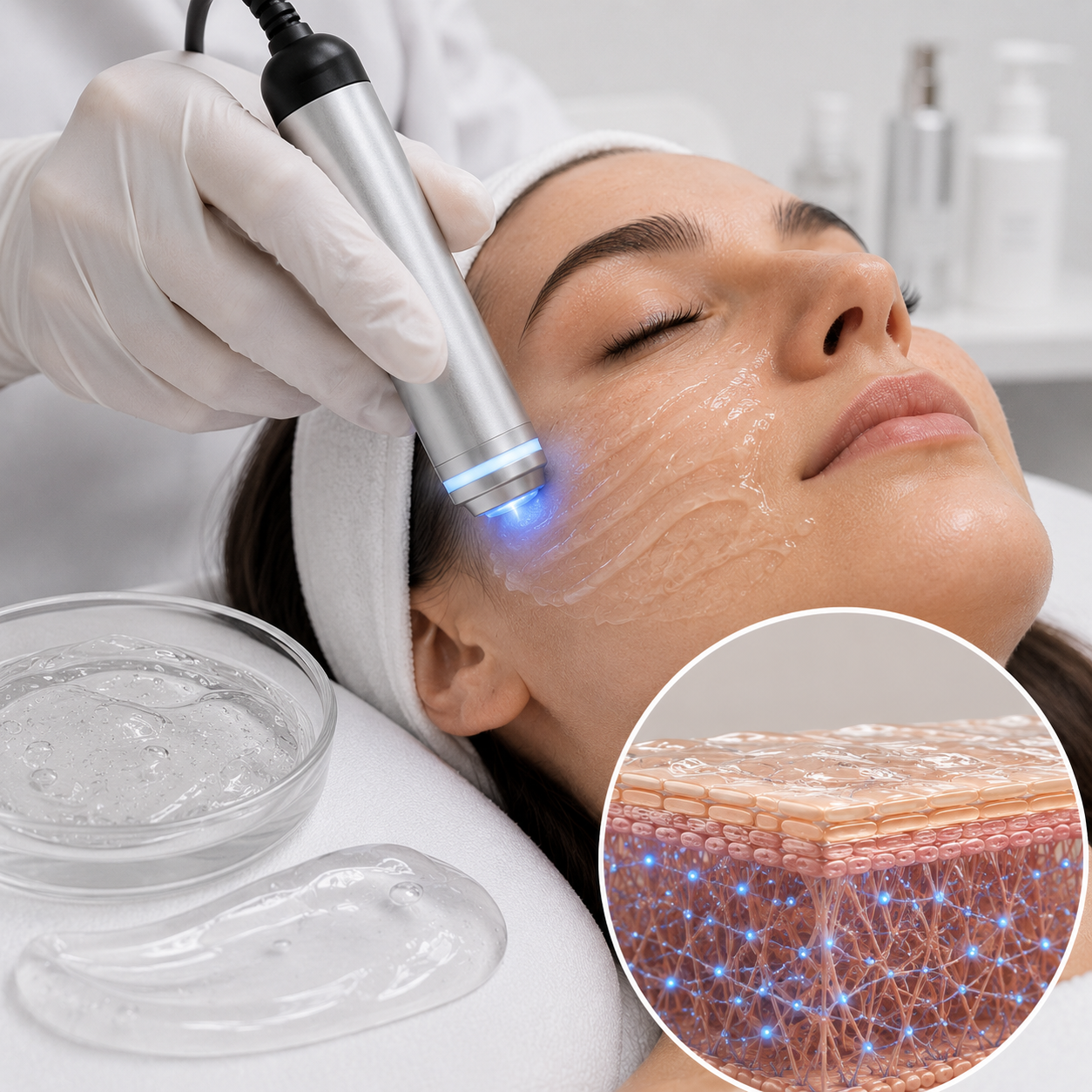
Iontophoresis works through the principle of electrical charge. Like charges repel each other, while opposite charges attract each other. During a professional iontophoresis treatment, a compatible formula is applied to the skin and a device delivers a controlled low-level electrical current through the treatment area.
Charged ingredients in the formula can be influenced by this electrical field. For example, negatively charged molecules may be supported by a negative electrode because the same charge creates repulsion. This can help encourage the movement of compatible molecules away from the electrode and toward the skin surface.
The effectiveness of iontophoresis depends on several important factors: the polarity of the ingredients, the conductivity of the formula, the hydration level of the skin, the condition of the skin barrier, the treatment duration, and the device settings selected by the professional.
A successful iontophoresis treatment is therefore not only about the device. It is the result of a complete system: professional technology, compatible formulation, correct skin preparation, and trained application technique.

The Role of the Skin Barrier
The skin barrier is one of the most important structures in cosmetic science. The outermost layer of the skin, called the stratum corneum, is made of flattened skin cells surrounded by a lipid matrix. This structure is often compared to a brick wall: the skin cells are the bricks, and the lipids are the mortar.
This protective barrier is essential for healthy skin. It helps prevent water loss, protects against environmental stress, and limits the entry of unwanted substances. At the same time, it also makes cosmetic delivery more challenging because many active ingredients cannot easily pass through the skin by passive application alone.
Iontophoresis supports a more advanced delivery environment without damaging the skin barrier. It does not create wounds, does not inject ingredients, and does not require needles. Instead, it uses mild electrical energy and a compatible conductive formula to improve contact, hydration, and ingredient distribution in the surface and upper epidermal layers.
This makes iontophoresis highly relevant for professional skincare protocols that aim to improve visible skin quality while respecting the natural protective function of the skin.
Why Conductive Formulas Are Essential
A professional iontophoresis treatment requires more than a device. The formula used during the treatment is essential. A suitable iontophoresis gel or serum must support even electrical contact between the device and the skin while providing smooth glide, stable texture, hydration, and skin comfort.
If a formula is not conductive enough, the electrical current may not be distributed evenly. If the formula is too watery, it may not remain stable on the skin during treatment. If it is too heavy or occlusive, it may interfere with device movement and reduce professional performance.
This is why iontophoresis formulas must be carefully developed. They need to combine conductivity, active ingredient stability, skin compatibility, and a professional texture that allows the device to move smoothly across the treatment area.
CELONÍQUE professional formulas are designed for advanced aesthetic environments where delivery support, texture, hydration, skin comfort, and active ingredient distribution are all important. This makes CELONÍQUE highly compatible with iontophoresis-based protocols when used with suitable devices and trained professional application.

The History of Iontophoresis
18th–19th Century: The Foundation of Electrical Science
The scientific foundation of iontophoresis began with early studies of electricity, charged particles, and biological tissues. Scientists discovered that electrical current could influence the movement of ions and charged substances in fluids. These discoveries created the basis for later technologies that use electrical fields to guide the movement of molecules.

The History of Iontophoresis
Early 20th Century: Iontophoresis Becomes Defined
In the early 20th century, iontophoresis became recognized as a method for transporting charged substances through tissues using low-intensity electrical current. It was studied in medical, pharmaceutical, and physiotherapy settings as a non-invasive delivery principle. This period helped establish iontophoresis as a controlled scientific method rather than only an experimental electrical concept.

The History of Iontophoresis
Dermatology and Aesthetic Application
Over time, iontophoresis became relevant in dermatology and professional aesthetic skincare. Its non-invasive nature made it attractive for treatments focused on topical delivery support, hydration, and visible skin improvement. Unlike injections or mechanical skin disruption, iontophoresis offered a way to support compatible formulas while respecting the skin surface.

The History of Iontophoresis
Today: Advanced Cosmetic Delivery Systems
Today, iontophoresis is used with more advanced cosmetic formulas, including hydrating gels, peptides, antioxidants, soothing complexes, and biotechnology-inspired skincare systems. Its success depends on the synergy between device, formula, skin preparation, and professional expertise. This is why modern iontophoresis is no longer only about electrical current; it is about the complete treatment environment.
Why Iontophoresis Works Well with CELONÍQUE
Boosted Plant-Based Exosomes
CELONÍQUE uses boosted plant-based exosome complexes inspired by cellular communication and visible skin vitality. Iontophoresis supports a more active treatment environment by improving formula contact, hydration, and distribution across the skin surface and upper epidermal layers.
Multi-Polypeptide Complex
Peptides are important in modern anti-aging skincare because they support the appearance of smoother, firmer, and more resilient skin. In professional protocols, iontophoresis helps distribute compatible peptide formulas more evenly during the treatment.
Non-Invasive Regenerative Beauty
CELONÍQUE focuses on advanced non-invasive skincare. Iontophoresis fits this philosophy because it supports cosmetic delivery without needles, injections, surgery, or aggressive skin disruption. It creates a professional bridge between technology and luxury biotech skincare.
Frequently Asked Questions
IONTOPHORESIS
How often can an iontophoresis treatment be performed?
The frequency depends on the skin condition, treatment goal, device settings, and professional protocol. In aesthetic skincare, iontophoresis is often used as part of a treatment series rather than as a single isolated session. A professional may recommend weekly sessions during an intensive phase, followed by maintenance treatments depending on the skin’s response.
Can iontophoresis be combined with other professional technologies?
Yes, iontophoresis can be integrated into broader professional skincare concepts, but the order and combination must be selected carefully. It may be combined with technologies such as LED light, soothing masks, hydrating treatments, or gentle professional facials. Strong exfoliation, aggressive resurfacing, or heat-based treatments should be evaluated individually to avoid overstimulation.
Is special skin preparation needed before iontophoresis?
Yes. The skin should be properly cleansed before treatment so that makeup, oil, sunscreen, and surface impurities do not interfere with formula contact. In some protocols, a gentle preparation step may be used to improve the skin surface. However, the skin should not be irritated, wounded, or freshly over-exfoliated before iontophoresis.
What should be avoided after an iontophoresis treatment?
After treatment, the skin should be kept calm and protected. Strong exfoliating acids, retinoids, aggressive scrubs, heat exposure, sauna, and intensive sun exposure are usually avoided immediately after the session. A gentle moisturizing and barrier-supporting routine is recommended to maintain comfort and support the visible result.
Who is the ideal customer for an iontophoresis facial?
Iontophoresis is suitable for clients looking for a non-invasive professional treatment focused on hydration, glow, skin freshness, smoother appearance, and advanced cosmetic delivery support. It is especially interesting for clients who want visible skin improvement without injections, needles, surgery, or downtime.
Invalid password
Enter

MADE IN GERMANY

100% VEGAN

Exosome Technology
STAY INFORMED
CELONIQUE NEWSLETTER
Discover new offers, products, technologies, cooperations, and new CELONIQUE partner studios worldwide.